When it comes to chromatography, sample recovery is of utmost importance. And one major factor that...
The Problem
Flame retardants keep furniture from igniting. The chemicals used to do that job? They don't stay put.
Polybrominated diphenyl ethers (PBDEs) were the industry standard until their persistence, bioaccumulation, and toxicity made them untenable. Regulatory phase-outs began in the early 2000s. Organophosphate flame retardants (OPFRs) stepped in as replacements, offering solid performance and what appeared to be a better safety profile.
That perception didn't hold.
What the Data Shows
Through the 2010s, monitoring studies consistently detected OPFRs in indoor dust, surface water, wastewater, and human biological samples. Toxicological research linked certain OPFRs to endocrine disruption, neurodevelopmental effects, and potential carcinogenicity.
OPFRs are no longer "safer alternatives." They're chemicals of emerging concern, and labs need dependable methods to detect them in environmental matrices.
The Right Sorbent for the Job
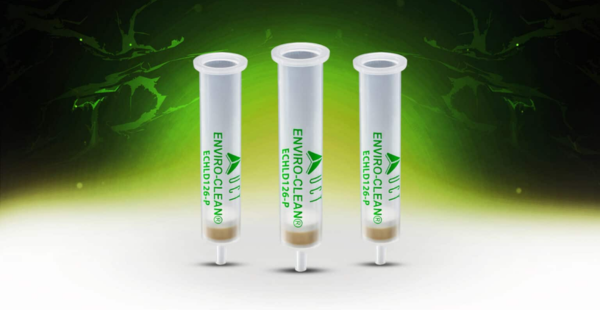
OPFRs in water samples demand a sorbent with broad-spectrum retention for semi-polar to non-polar analytes. UCT's highly cross-linked divinylbenzene (HLD) polymeric sorbent delivers exactly that: consistent recovery across the full range of OPFR chemistries without the variability you get from silica-based phases.
Recommended product: ECHLD126-P Enviro-Clean® HL DVB PE Frits, 200 mg / 6 mL
As the home of chromatography consumables, we stock UCT's Enviro-Clean range at prices that make routine environmental monitoring economically viable. High-quality consumables at unrivalled prices, making your lab budget go further.
SPE Protocol: OPFRs in Water by GC-MS
1. Sample Pretreatment
Adjust sample pH to 2–3 using 6N sulfuric acid.
2. SPE Procedure
- Wash with 5 mL ethyl acetate
- Condition with 5 mL methanol
- Equilibrate with 5 mL water
- Load sample
- Rinse the sample bottle twice with 5 mL reagent water; transfer both rinses to the cartridge (critical step: highly hydrophobic compounds such as EHDPP and TEHP adsorb onto glass surfaces)
- Wash the cartridge with 2.0 mL reagent water, twice
- Dry at maximum vacuum for 10–20 minutes
- Place collection tubes in manifold
- Rinse the sides of the sample bottle with 2 mL 1:1 ethyl acetate:dichloromethane; transfer onto the cartridge under low vacuum
- Elute with 2 mL 1:1 ethyl acetate:dichloromethane. Repeat three times.
- Apply maximum vacuum for 30 seconds
- Dry extract through sodium sulfate into a concentrator tube
- Evaporate to ~800 µL
- Reconstitute to 1 mL with dichloromethane
- Analyse by GC-MS in SIM mode
Why Chromatography Direct
We're not just for chromatography. We're so much more than chromatography. SPE cartridges, filtration, sample prep consumables: if your lab needs it, we supply it. High-quality consumables making your lab budget go further.
We're specialists, not generalists. That means we know which sorbent works for your OPFR application, we carry it in stock, and we deliver it at unrivalled prices. If you're running environmental screening, talk to us about UCT SPE cartridges and bulk pricing.
References
- Hu, Y.; Li, P.; Yin, X.; Ban, D. Chin. J. Anal. Chem. 2012, 40 (11), 1693–1697. DOI: 10.1016/S1872-2040(11)60586-0.
- Rodil, R.; Quintana, J. B.; Reemtsma, T. Anal. Chem. 2005, 77 (10), 3083–3089. DOI: 10.1021/ac048247s.
- Li, J.; Yu, N.; Zhang, B.; Jin, L.; Li, M.; Hu, M.; Zhang, X.; Wei, S.; Yu, H. Water Res. 2014, 54, 53–61. DOI: 10.1016/j.watres.2014.01.031.