
Not all syringe filters are created equal. The membrane you choose directly affects your results, your column lifespan, and your budget. Pick the wrong one and you'll get extractables in your baseline, blocked pores mid-filtration, or worse, lost analyte.
At Chromatography Direct, we stock 13 membrane types across multiple pore sizes and diameters. This guide cuts through the noise and tells you exactly which filter to use for your application.
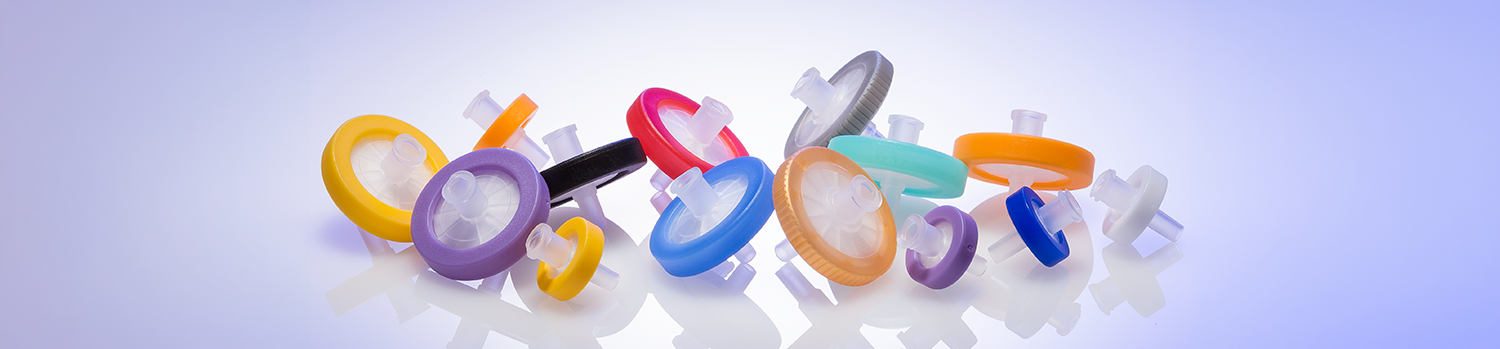
The Quick Answer
For most HPLC sample prep with mixed aqueous-organic solvents, Nylon 0.45 µm is the industry default. It's chemically compatible with a broad range of solvents, affordable, and does the job. But "most" isn't "all", and choosing the right membrane for your specific matrix will give you cleaner chromatography and fewer headaches.
Membrane Types Compared
Nylon
Best for: General HPLC sample prep, mixed aqueous and organic solvents.
Nylon is the workhorse membrane. It's hydrophilic, so it wets easily without pre-treatment, and it handles both aqueous and organic solvents. The trade-off? It has moderate protein binding, so it's not ideal for biological samples where you need full analyte recovery. It's also not suitable for strongly acidic solutions (below pH 3) as the membrane can degrade.
Avoid for: Protein-rich samples, strong acids.
PTFE (Hydrophobic)
Best for: Aggressive organic solvents, strong acids and bases.
PTFE is the most chemically inert membrane available. If your sample contains concentrated acids, bases, or solvents that would dissolve other membranes, PTFE is your only option. The catch: it's hydrophobic, meaning it won't wet with aqueous solutions unless you pre-wet with methanol or another organic solvent first.
Avoid for: Purely aqueous samples (unless pre-wetted).
PVDF (Polyvinylidene Fluoride)
Best for: Biological samples, protein recovery, LCMS work.
PVDF offers low protein binding and broad chemical compatibility. It handles most organic solvents and aqueous solutions without issues. It's become the go-to membrane for pharmaceutical and bio-analytical labs where sample recovery matters. If you're running LCMS and need low extractables, PVDF is a strong choice.
Avoid for: Highly aggressive solvents like DMSO or DMF at high concentrations.
PES (Polyethersulfone)
Best for: Aqueous samples, tissue culture media, high-flow applications.
PES has the fastest flow rates of any membrane, which matters when you're filtering viscous samples or processing high volumes. It's hydrophilic with very low protein binding. The downside is limited organic solvent compatibility, so it's strictly for aqueous or mildly organic matrices.
Avoid for: Organic solvents above 20% concentration.
MCE (Mixed Cellulose Ester)
Best for: General aqueous filtration, particle analysis, environmental monitoring.
MCE is affordable and hydrophilic with good flow characteristics. It dissolves cleanly in certain solvents, which makes it useful for gravimetric or particulate analysis where the filter itself needs to be removed from the equation. Not ideal for organic solvents or long-term chemical exposure.
Avoid for: Organic solvents, acidic or basic solutions.
Glass Fibre (GF)
Best for: Pre-filtration of heavily particulate samples, high-solids matrices.
Glass fibre filters have a much higher dirt-loading capacity than membrane filters. They're designed to handle samples that would immediately clog a standard membrane. Often used as a pre-filter in combination with a membrane, or alone when precise pore-size cut-off isn't critical.
Avoid for: Applications requiring a defined pore-size exclusion.
Regenerated Cellulose (RC) / Universal Membrane
Best for: Dissolution testing, broad solvent compatibility with low extractables.
RC membranes offer excellent compatibility with both aqueous and organic solvents, very low extractables, and minimal protein binding. They're particularly popular in pharmaceutical dissolution testing where regulatory requirements demand minimal filter interference.
Avoid for: Strongly basic solutions.
Pore Size: 0.22 µm vs 0.45 µm
The rule is straightforward:
- 0.45 µm is standard for HPLC. It removes particulates that would damage your column and injector while maintaining good flow rates.
- 0.22 µm is recommended for UHPLC systems with sub-2 µm column packings, or when you need to remove bacteria for sterile filtration.
Going smaller than you need just makes filtration slower and increases the risk of analyte adsorption. Don't over-specify.
Diameter: Which Size Do You Need?
- 4 mm: Micro-volumes, typically under 0.5 mL. Common in LCMS applications.
- 13 mm: The standard for sample volumes up to about 2 mL.
- 25 mm: For larger volumes, typically 2–10 mL.
- 33 mm: High-volume filtration, 10 mL and above.
Common Mistakes
Using Nylon for protein samples. You'll lose analyte to the membrane. Switch to PVDF or PES.
Not pre-wetting PTFE before aqueous use. The filter will airlock. Flush with methanol first.
Using PES with organic mobile phases. The membrane isn't compatible. Use Nylon or PTFE instead.
Over-specifying pore size. A 0.22 µm filter on a standard HPLC system just slows you down without measurable benefit.
Why Chromatography Direct?
We stock all major membrane types in multiple pore sizes and diameters, at prices that make your lab budget go further. Every syringe filter we sell is designed for low extractables and consistent performance, batch after batch.
Need help choosing the right filter for your application? Our team of scientists can advise. Call us on +44 (0) 1925 599070, use the chat or browse our full syringe filter range online.