


United Chemical Technologies is widely known for our high-quality solid phase extraction products...
Calibrating your pH meter correctly is the fastest way to improve accuracy, reduce drifting readings, and make your results repeatable between users. In this guide, I’ll walk through a practical calibration process, then explain when to use 2‑point vs 3‑point calibration.
What calibration actually does
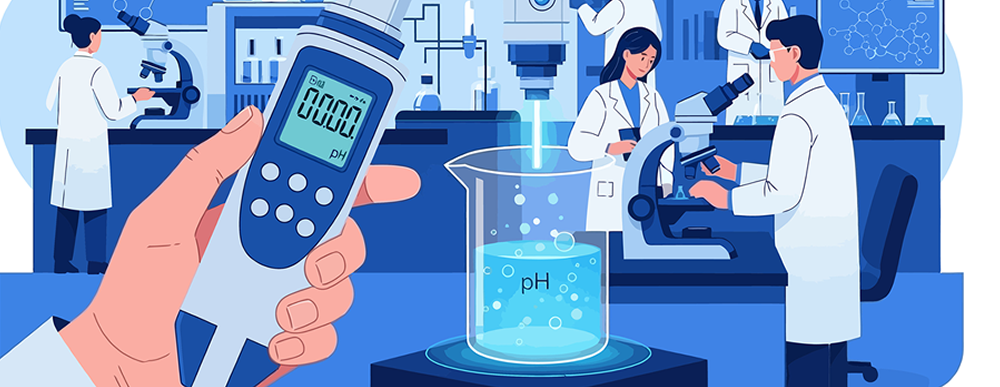
A pH electrode produces a voltage that changes with pH. Calibration tells the meter what “known pH” looks like using buffer solutions so that it can translate the electrode signal into an accurate pH reading.
If calibration is rushed or inconsistent, you’ll see symptoms like:
-
Readings that drift or won’t stabilise
-
A meter that seems “wrong” even in buffer
-
Different results from different operators
-
Slow response times
Before you start: what you need
-
Your pH meter and electrode (probe)
-
Fresh pH buffer solutions (commonly pH 7.00 plus either pH 4.01 and/or pH 10.01)
-
Clean rinse water (deionized or distilled is typical)
-
Clean beakers or cups (one per buffer is best)
-
Lint-free tissue (for gentle blotting, not wiping)
-
A thermometer if your meter does not have ATC (automatic temperature compensation)
Tip: Use separate containers for each buffer. Do not pour the used buffer back into the bottle.
The simple rule for choosing 2‑point vs 3‑point calibration
Use 2‑point calibration when:
-
You are measuring mostly on one side of neutral (mostly acidic or mostly alkaline)
-
You want a fast, reliable routine for day-to-day work
-
Your required accuracy is typical for routine checks
A common 2‑point setup is:
-
pH 7.00 and pH 4.01 (for mostly acidic samples)
-
pH 7.00 and pH 10.01 (for mostly alkaline samples)
Use 3‑point calibration when:
-
You measure across a wide range (acidic, neutral, and alkaline)
-
You need higher confidence across the full scale
-
You are troubleshooting accuracy issues
-
Your lab or process requires tighter control
A common 3‑point setup is:
-
pH 4.01, pH 7.00, and pH 10.01
In practice, 3‑point calibration takes a little longer but can improve reliability when your sample pH varies a lot.
Step-by-step: how to calibrate a pH meter correctly
The steps below apply for pen type, portable, tablet-based, and laboratory pH meters. Your button names may differ, but the workflow is the same.
Step 1: Prepare your buffers and workspace
-
Pour a small amount of each buffer into clean containers.
-
Let buffers reach the same temperature as your measurement environment if possible.
-
Make sure your electrode is hydrated (never store a typical glass pH electrode dry).
Why it matters: Temperature affects pH readings and electrode response. Consistency is the goal.
Step 2: Inspect and rinse the electrode
-
Inspect the probe for damage, salt crusting, or air bubbles (if visible).
-
Rinse the electrode with clean water.
-
Gently blot dry with lint-free tissue.
Important: Do not wipe the glass bulb aggressively. Wiping can create static and cause unstable readings.
Step 3: Start with a pH 7.00 buffer
Most workflows start at neutral (pH 7.00) because it anchors the calibration in the middle of the scale.
-
Place the electrode in a pH 7.00 buffer.
-
Stir gently or swirl, then stop and allow the reading to stabilise.
-
Enter calibration mode and confirm/accept the buffer when stable.
Stability tip: “stable” usually means the reading changes very slowly for several seconds. Many meters also show a stability indicator.
Step 4: Rinse, then calibrate the second point (acidic or alkaline)
Choose your second buffer based on your sample type.
- If your samples are usually acidic, use pH 4.01
-
If your samples are usually alkaline, use pH 10.01
Process:
-
Rinse the electrode.
-
Blot gently.
-
Place in the second buffer.
-
Allow it to stabilise.
-
Accept/confirm the buffer.
At this stage, you have completed 2‑point calibration.
Step 5 (optional): Add the third point for a 3‑point calibration
If you are doing a 3‑point calibration, add the remaining buffer:
- If you already used pH 4.01 as the second point, use pH 10.01 as the third point.
-
If you already used pH 10.01 as the second point, use pH 4.01 as the third point.
Repeat the same rinse, blot, stabilize, accept routine.
Step 6: Verify calibration (quick confidence check)
A best practice is to verify calibration by checking a buffer you have not used, or by re-checking pH at 7.00.
- If you calibrated with pH 7 and pH 4, you can spot-check pH 10 (optional) or re-check pH 7.
-
If you calibrated with three points, re-check pH 7 at the end.
If the meter is significantly off in the buffer immediately after calibration, something is wrong (buffer, probe condition, contamination, temperature mismatch).
Common calibration mistakes (and how to avoid them)
1) Using old or contaminated buffers
Buffers exposed to air and repeated probe dips can change over time.
Fix:
- Use a fresh buffer.
-
Pour out a small amount each time.
-
Never return used buffer to the bottle.
2) Not rinsing between buffers
Cross-contamination is one of the most common causes of poor calibration.
Fix:
-
Rinse thoroughly and blot between each buffer.
3) Wiping the electrode instead of blotting
Wiping can create static charge and unstable readings.
Fix:
-
Blot gently with lint-free tissue.
4) Calibrating at a different temperature from the measurement
Calibration at one temperature and measurement at another can introduce error.
Fix:
-
Let buffers and samples equilibrate to similar temperatures.
-
Use ATC when available and ensure the temperature sensor is properly placed.
5) Calibrating too quickly (not waiting for stability)
If you accept a buffer point too early, you lock in an error.
Fix:
-
Give the electrode time to respond, especially if it has been stored dry or the probe is ageing.
When to recalibrate
There is no single schedule for every workflow, but good triggers include:
-
At the start of each day (common in routine work)
-
Before critical measurements
-
After changing the electrode or cleaning it
-
After measuring difficult samples (oily, dirty, highly buffered, etc.)
-
When readings drift or become slow to stabilise
A simple approach for repeatability: calibrate at the start of the day and verify with pH 7 mid-shift (or before key runs).
2‑point vs 3‑point: which should you choose?
Use this quick decision guide:
-
Mostly acidic samples (around pH 2 to 6): 2‑point (pH 7 + pH 4)
-
Mostly alkaline samples (around pH 8 to 12): 2‑point (pH 7 + pH 10)
-
Wide range samples (acidic and alkaline): 3‑point (pH 4 + pH 7 + pH 10)
-
Troubleshooting accuracy issues: 3‑point + verification checks
If you are buying meters for a teaching lab or field team, a consistent 2‑point routine often gives the best balance of speed and reliability. If your samples vary widely, a 3‑point is usually worth the extra time.
Practical checklist (copy/paste)
-
Fresh buffers prepared in clean containers
-
Electrode rinsed and gently blotted
-
Calibrate at pH 7.00 first
-
Add pH 4.01 or pH 10.01 depending on samples
-
Add third point if needed
-
Verify in pH 7.00 after calibration
-
Record date/time and operator for repeatability
Need help choosing the right pH meter setup?
If you tell us your use case (education lab or water testing), expected pH range, and quantity, we can recommend an appropriate meter type and respond with a quote within 24 hours.